Sharing this Facebook post because:
a) I love the Library of Congress,
b) I love cats, and
c) I particularly love cats in ridiculous costumes.
But mostly because I hate seeing AI used in ways that don’t actually improve the user experience.
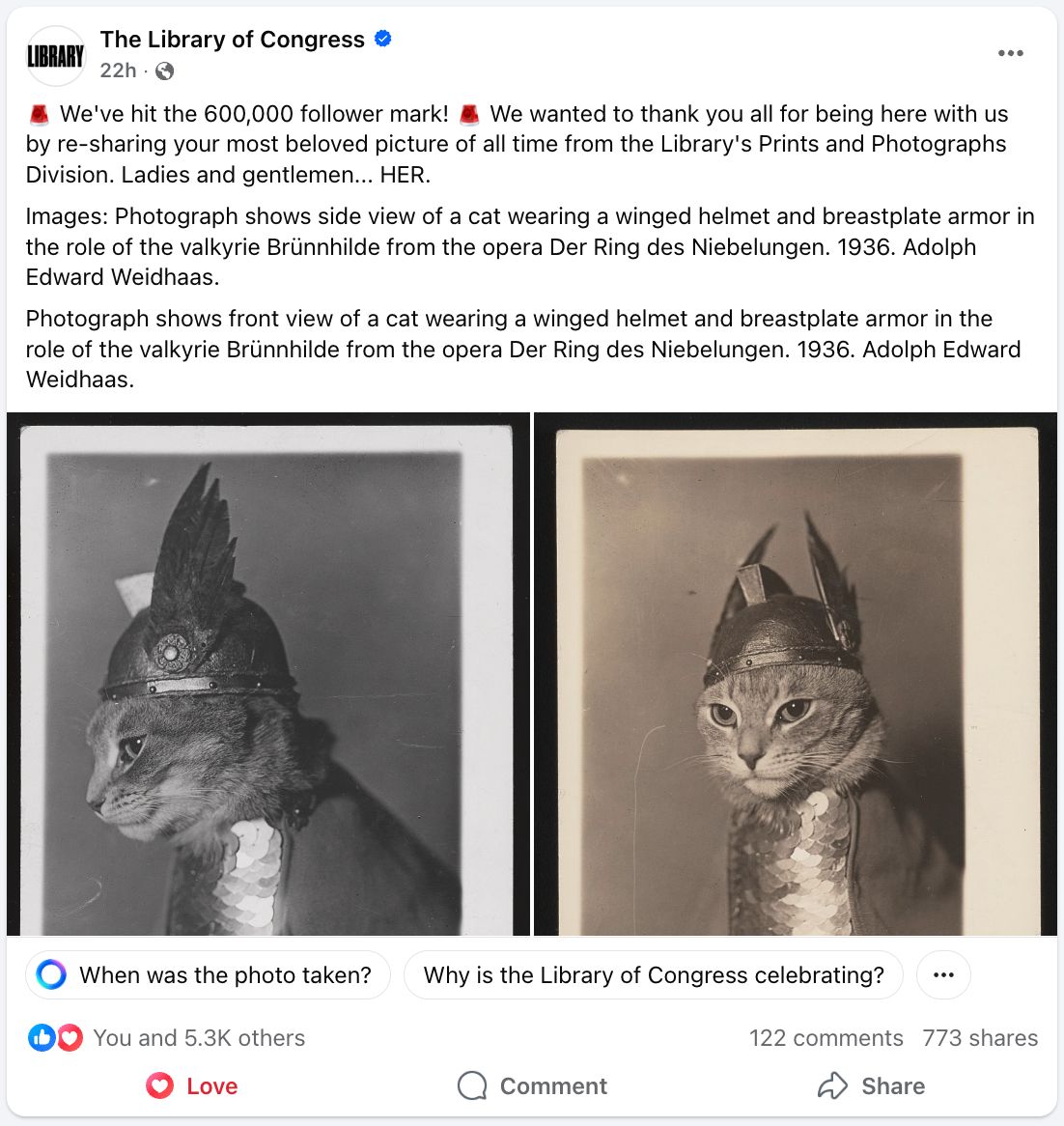
Yesterday the Library of Congress posted this:
“🚨 We’ve hit the 600,000 follower mark! 🚨 We wanted to thank you all for being here with us by re-sharing your most beloved picture of all time from the Library’s Prints and Photographs Division. Ladies and gentlemen… HER.
Images: Photograph shows side view of a cat wearing a winged helmet and breastplate armor in the role of the valkyrie Brünnhilde from the opera Der Ring des Niebelungen. 1936. Adolph Edward Weidhaas.”
First of all: 10/10. No notes. A valkyrie cat from 1936 is peak archival content.
But then, at the bottom of the post, Meta’s AI-generated prompts:
- When was the photo taken?
- Why is the Library of Congress celebrating?
I understand why these prompts exist. Meta wants engagement. It wants its product (us) to interact, click, ask, generate, stay. Fine.
But these decisively non-intelligent prompts read less like an invitation to explore and more like a middle school reading comprehension quiz. The answers are literally in the post.
The Core AI User Experience Problem
AI is being deployed because it can be — not because it meaningfully improves the experience.
These prompts don’t deepen understanding.
They don’t spark curiosity.
They don’t surface hidden context.
They don’t invite interpretation.
They simply restate what’s already there.
And that means they cost us something — time, attention, cognitive load, and yes, natural resources — while adding exactly zero value.
If Meta’s AI was intelligent in a human-centered way, it would know when to stay quiet. It would recognize that this post already works. It would suppress itself.
Because good design isn’t about inserting interaction everywhere. It’s about discernment.
Sometimes the best user experience is:
Here is a magnificent 1936 valkyrie cat. Enjoy.
👉 Go support our Library of Congress’ Facebook Post